


Mumbai Redevelopment Projects in 2026: The Property Story That Is Reshaping the City
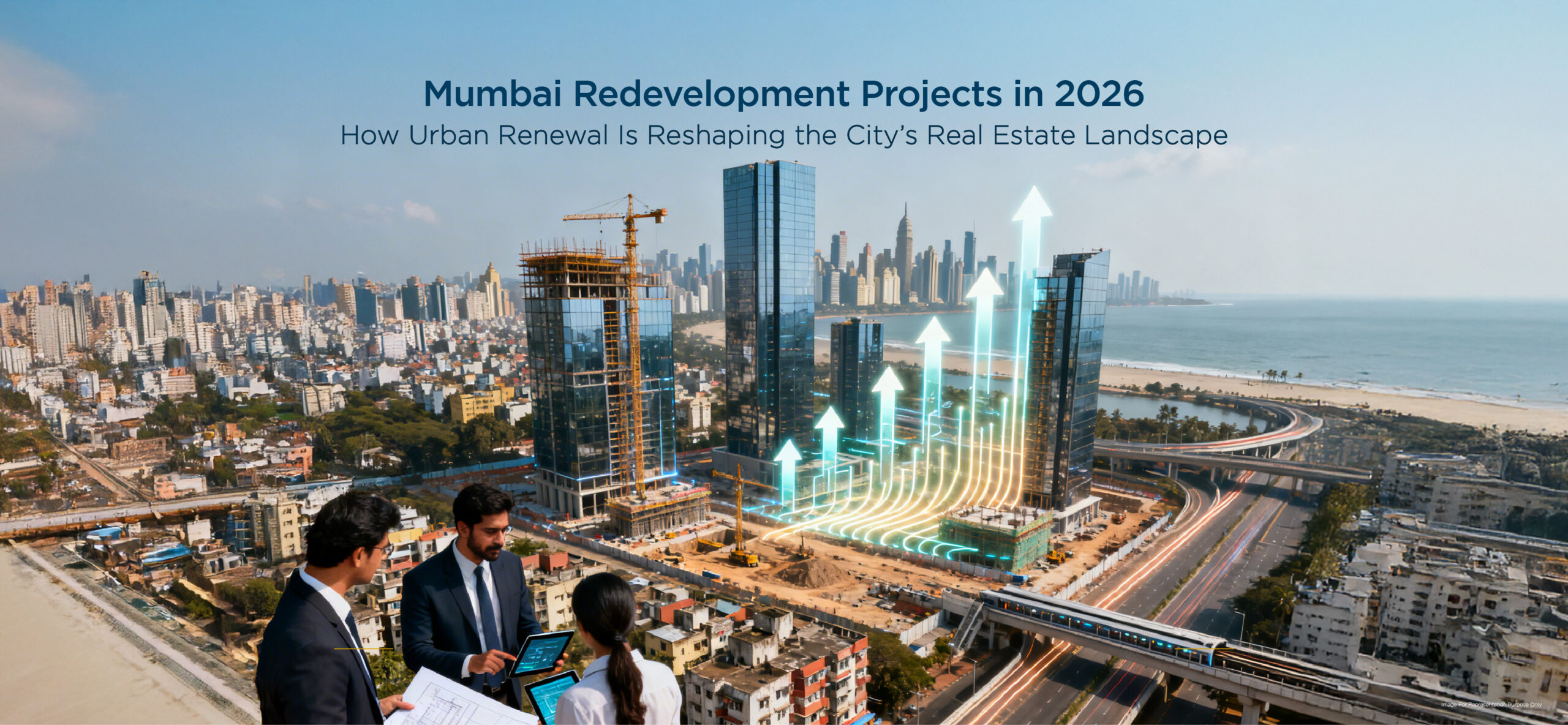
Mumbai has no new land. Every buyer, investor, and developer working in this market understands this at some level. The answer the city has arrived at is redevelopment. Pulling down what no longer works and building something better in its place. In 2026, that answer is now the dominant force behind Mumbai property price growth, neighbourhood transformation, and a serious investment opportunity.
Why the Redevelopment Boom is Real
The scale of eligible stock is what most people underestimate. Of the roughly 19,500 cessed buildings Mumbai had in 1955–56, approximately 13,000 remain pending for redevelopment. These are rent-controlled structures built before 1969, many of which are structurally compromised. In 2025, MHADA declared 96 cessed buildings in South Mumbai as extremely dangerous and asked residents to vacate. Society redevelopment in the suburbs has matched this urgency. By the end of the last financial year, more than 31,000 society redevelopment projects had been approved across Mumbai, with redevelopment now accounting for an estimated 30–40% of the city’s new housing supply.
Government policy is actively accelerating this. Mumbai City’s residential FSI has been raised from 1.33 to 3. Higher FSI is the financial engine of every redevelopment project, as it is what makes complex urban projects viable for developers in the first place. MHADA has also cut approval timelines significantly. Redevelopment proposals for cessed buildings with 51% resident consent now receive a No Objection Certificate within six weeks, with the NOC deemed approved if the deadline is missed.
What Redevelopment Does to Property Prices
The pricing impact is measurable and, in several pockets, dramatic. When an ageing building gives way to a modern high-rise, the valuation benchmark for that entire neighbourhood resets.
Greater Mumbai’s premium on new homes over resale has risen from about 5% in 2016 to 23% in 2025, with average primary prices standing at around ₹35,602 per sq ft as of December 2025. In the most active redevelopment corridors, the gap runs wider. South Mumbai shows a premium of about 46% for new homes, the Western suburbs around 44%, and the Eastern suburbs have seen the premium jump from just 2% in 2016 to about 30% in 2025, largely driven by redevelopment and large integrated projects.
The broader market has confirmed this momentum. In 2025, Mumbai recorded 150,254 property registrations and stamp duty collections of ₹13,487 crore. Both these are 14-year highs, per Knight Frank India.
SRA Redevelopment and What It Unlocks
SRA redevelopment works on a public-private partnership model. Developers receive enhanced FSI rights in exchange for providing free housing to eligible slum residents, with additional apartments sold in the open market to fund the project. The cumulative output is now substantial.
According to the Maharashtra Economic Survey 2025–26, 2,545 SRA projects have been completed over nearly three decades, with around 500 delivered in the five years following the COVID-19 pandemic, which is roughly 18% of all output in that window alone. Free Press Journal The target going forward is even more ambitious. Mumbai aims for 5 lakh SRA homes by 2030, roughly double the cumulative output since 1996.
For investors, these zones matter because they represent land unlocks in locations that were previously inaccessible for formal real estate. As informal settlements are replaced by planned towers, the surrounding micro-markets reprice accordingly.
Premium Redevelopment Zones: Where to Pay Attention
Several corridors stand out for the pace and quality of transformation currently underway. Here is where the action is concentrated in 2026:
- South Mumbai: Luxury redevelopment is resetting price ceilings. South and South-Central Mumbai lead city pricing at ₹45,000–75,000 per sq ft for 2BHK apartments, driven by land scarcity and redevelopment-led supply.
- Bandra: The city’s most aspirational address for premium buyers. Redevelopment here operates at the intersection of location scarcity and lifestyle permanence, producing consistent demand.
- Andheri: One of the most active zones for new launch redevelopment projects in Mumbai, with metro connectivity and a broad commercial catchment, making it relevant to a wide range of buyers.
- Borivali and Kandivali: Where the arithmetic of society redevelopment, Mumbai is playing out most visibly. According to Knight Frank India (2025), the western suburbs will contribute around 32,354 of the 44,000 new homes expected from society redevelopment by 2030, approximately 73% of the total.
- Dadar and Chembur: Among Mumbai’s most active zones for redevelopment-driven residential sales, targeting new-age features and green building standards to meet buyer demand.
The Investment Case for Redevelopment Investment Opportunities
Property investment in Mumbai’s redevelopment zones has a specific logic that long-horizon buyers and NRI investors should understand.
Early-entry pricing matters. A project acquired at the pre-launch phase of a redevelopment typically prices below comparable ready inventory in the same neighbourhood. As the tower completes and the area reprices, the gap closes in the investor’s favour. Supply scarcity reinforces this. Mumbai’s inventory overhang now stands at a 5-year low of 20 months, with land scarcity and lengthy approval cycles keeping new supply constrained. In established neighbourhoods where redevelopment is the only route to new supply, that scarcity is structural.
Rental demand in redeveloped towers with good infrastructure access has remained solid, supported by consistent employment across financial services and technology sectors. City-wide residential price appreciation has held at 4–6% year-on-year, driven by end-user absorption and disciplined supply. In active redevelopment corridors, appreciation has run ahead of that average.
Mumbai infrastructure development tied to redevelopment zones adds another layer. Metro expansion, the Coastal Road, and MTHL connectivity are directly lifting the investment case for pockets that were considered secondary just five years ago.
The Bottom Line
Urban renewal in Mumbai is doing more than replacing old buildings. It is systematically creating modern housing supply in a land-locked city, repricing neighbourhoods, and generating appreciation that has outpaced broader market averages across multiple corridors. The pipeline of 13,000 cessed buildings and 31,000-plus approved society projects means this wave has years of momentum ahead of it.
Explore 100% verified redevelopment listings on BeyondWalls, or schedule a free consultation call with our experts to find the right opportunity in Mumbai’s most transforming neighbourhoods.
Thank you. Your comment will be visible after an approval.
Comments (0)
No comments found.


Add your comment