


Appreciation depends on actual project execution and surrounding infrastructure. Operational airports with supporting metro and highway access typically show stronger performance than projects delayed by approvals.
How India’s Airport Expansion Is Reshaping Real Estate Markets
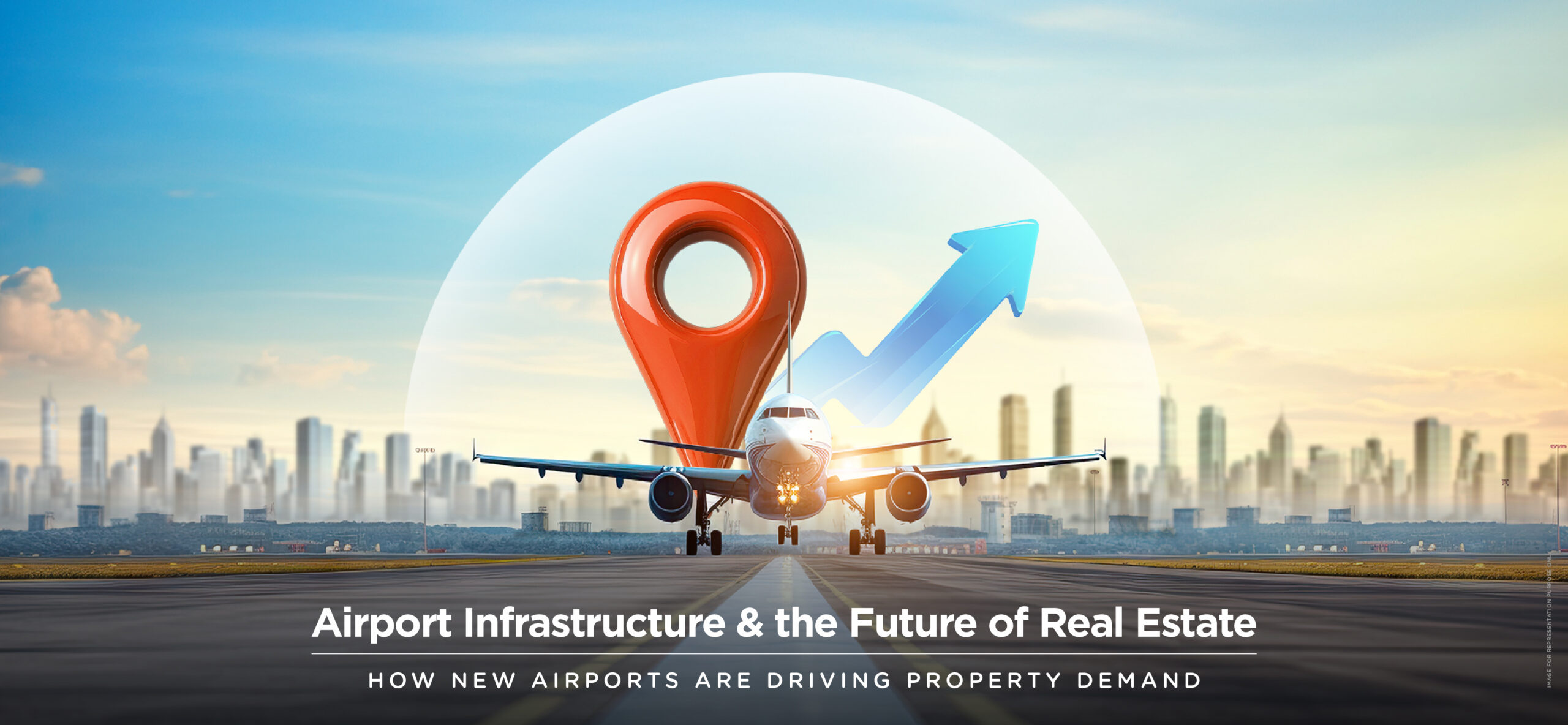
India is in the middle of one of the largest aviation expansion phases in its history. According to the Ministry of Civil Aviation, India plans to add 50 new airports over the next five years, and policymakers have also outlined a long-term vision to significantly expand the number of operational airports nationwide. Greenfield airports in Navi Mumbai, Jewar near Noida, Mopa in Goa, and several Tier II and Tier III cities are already reshaping local economies.
For real estate, connectivity changes everything. When air access improves, business mobility increases. When business mobility increases, housing, office demand, and retail activity follow. Airports today function as economic anchors. The impact of airport infrastructure real estate development extends well beyond terminals and runways. It influences land values, rental markets, and long-term urban expansion patterns.
2.Infrastructure-Driven Real Estate Growth
Large infrastructure projects have always influenced property cycles. Metro corridors, expressways, and industrial parks create clear price movements over time. Airports operate on a larger scale.
An airport generates direct employment across airlines, ground services, logistics, hospitality, and retail. It also attracts indirect business activity such as IT firms, warehousing operators, consulting companies, and supply chain providers. As employment grows, residential demand follows.
According to Financial Express, the upcoming Noida International Airport at Jewar has accelerated residential activity along the Yamuna Expressway and Greater Noida, with property values rising sharply since the project announcement. Land transactions increased significantly even before operations began. This pattern is consistent across airport-led growth stories.
Improved air connectivity strengthens in-migration. Professionals relocate. NRIs invest in familiar corridors. Corporate capital flows toward well-connected hubs. Over time, these zones witness steady emerging city property demand, supported by job creation rather than speculation alone.
3.Airport-Led Micro-Market Expansion
The term “airport corridor” refers to the stretch of land and development that grows around major aviation hubs. Globally, this model is often called an aerotropolis. In simple terms, it is a city shaped around an airport.
As flight frequency increases, the land surrounding airports transforms. What was once peripheral or agricultural land begins hosting residential complexes, IT parks, business parks, logistics warehouses, hotels, and retail centers.
The Navi Mumbai International Airport is a clear example. Market reports highlight increased developer and investor interest in Panvel and Ulwe following progress updates on the Navi Mumbai International Airport. These locations, once considered distant, now form part of Mumbai’s expansion plan. Similar patterns are visible near Hyderabad’s Shamshabad and Bengaluru’s Devanahalli.
For investors, airport corridor investment often begins when land is still priced lower than established urban centers. Over time, as infrastructure matures, these areas evolve into structured micro-markets with stronger absorption and price resilience.
4.Residential vs Commercial Demand Shift
Residential demand typically rises first. Airline staff, airport employees, logistics managers, IT professionals, and hospitality workers seek homes within a reasonable commute. Developers respond with mid-income and premium housing, depending on city demographics.
Over time, commercial demand strengthens. Office parks emerge along access roads. Co-working spaces follow start-ups and satellite corporate offices. Warehousing and logistics hubs expand due to proximity to cargo terminals. Hospitality projects take shape to serve business travelers.
In early stages, residential assets often see quicker transaction activity and price momentum. Commercial assets, however, tend to deliver stronger long-term rental stability once occupancy stabilizes. Warehousing and Grade A office developments near operational airports can generate consistent yields, especially in cities witnessing rising air traffic.
For diversified portfolios, combining residential appreciation with commercial rental returns can balance risk exposure in airport-driven zones.
5.Investor Outlook Near Airport Zones
Investors often prefer airport-linked corridors because early entry creates room for appreciation before infrastructure reaches peak efficiency. Land parcels and plotted developments attract long-term holders. Apartments draw investors targeting rental income from professionals. Commercial spaces appeal to HNIs seeking steady yields.
Short-term investors usually enter during pre-launch or early announcement phases. Their focus remains capital appreciation as infrastructure milestones approach. Long-term land investors benefit when zoning approvals, metro extensions, and business parks strengthen the ecosystem.
Rental yields near operational airports vary by city. Knight Frank India’s office market reports indicate sustained leasing demand in cities such as Bengaluru and Hyderabad, supporting corridor-level growth across well-connected zones.
There are risks. Oversupply can pressure prices if multiple developers launch simultaneously. Speculative buying without assessing employment drivers may slow returns. Due diligence remains essential, especially regarding zoning, noise regulations, and infrastructure timelines.
6.Long-Term Capital Appreciation Factors
Airport-led growth gains strength when supported by complementary infrastructure. Metro connectivity, expressways, freight corridors, and industrial clusters multiply demand. Government-backed zoning plans reduce uncertainty and attract institutional capital.
Planned development prevents chaotic expansion. Dedicated business districts and logistics parks create sustained job generation. As jobs expand, housing absorption strengthens.
This model creates structural growth rather than short-term hype. Unlike theme-based launches or marketing-driven spikes, airport corridors rely on continuous passenger traffic, trade flows, and corporate activity. That consistency supports steady capital appreciation in airport infrastructure real estate corridors across emerging cities.
Airport expansion is reshaping urban India. For investors, NRIs, developers, and HNIs, identifying the right micro-market early can unlock sustained returns driven by connectivity and economic activity.
Explore High-Growth Property Markets
FAQ
2. Is residential or commercial better near airport corridors?
Residential demand appears earlier. Commercial assets often generate stronger long-term rental income once business districts mature.
3. Are airport zones suitable for long-term investment?
Yes, especially where government planning and employment drivers are clear. Long-term holding allows investors to benefit from phased development.
4. What risks should investors consider before buying near airports?
Check infrastructure timelines, zoning clarity, supply pipeline, and noise impact zones. Avoid speculative entry without understanding real demand drivers.
Thank you. Your comment will be visible after an approval.
Comments (0)
No comments found.Featured Articles

Proven Framework for High Velocity Launches
Recent Articles
Green Homes, Smarter Choices: The Rise of IGBC Certification in India

How Climate Change Is Reshaping Real Estate in Indian Cities

Property Possession Delays in India: Understanding RERA Rules, Compensation, and Buyer Rights

Mortgage Rates at 7.10% 2026 Forecast, Trends & Should You Buy Now

Why Mumbai Slum Redevelopment Projects Are Attracting Property Investors
Add your comment