


Slum redevelopment in Mumbai refers to SRA-led housing projects where informal settlements are replaced with formal residential buildings. Eligible residents receive rehabilitation homes, while developers gain rights to build and sell additional inventory.
Why Mumbai Slum Redevelopment Projects Are Attracting Property Investors
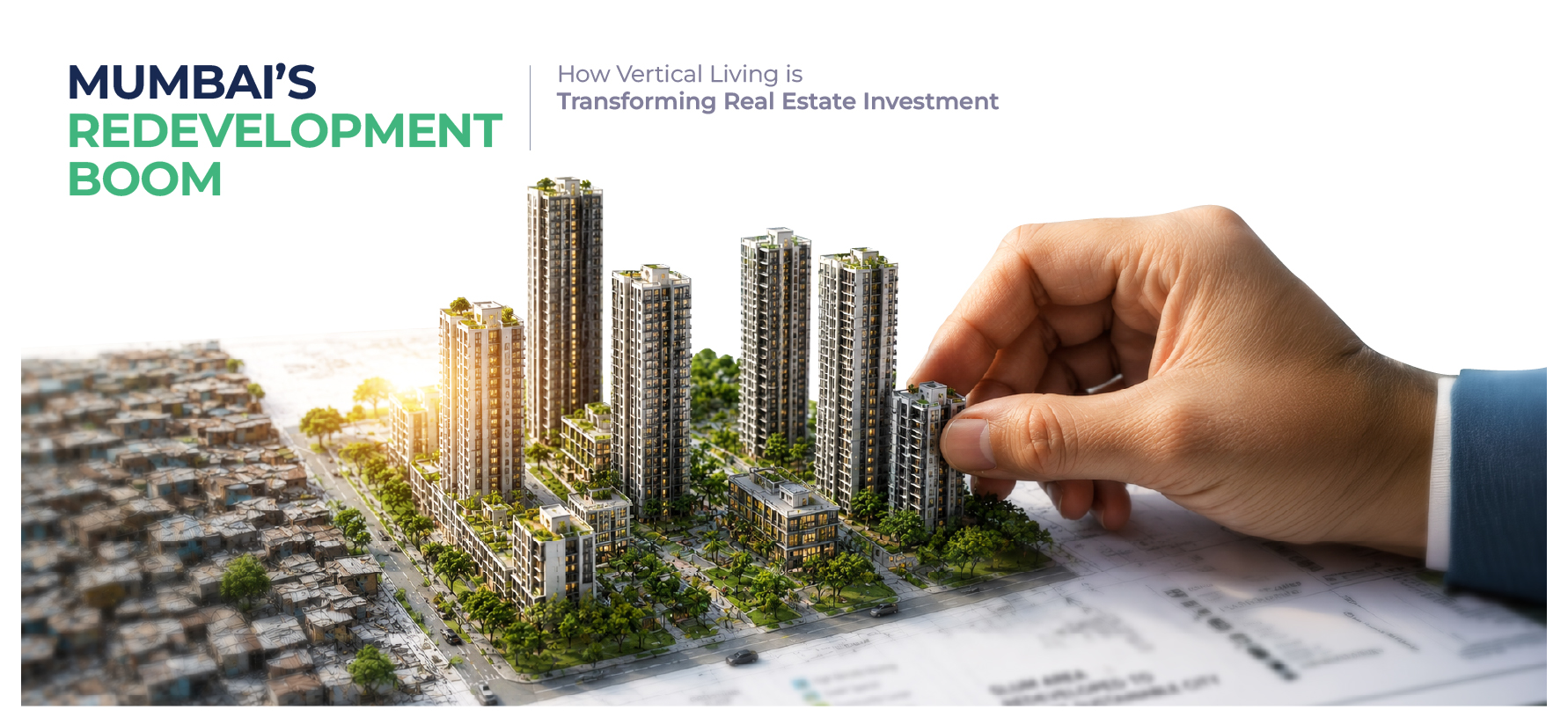
Mumbai houses more than 12 million people within one of India’s most land-constrained urban regions. With limited space for horizontal expansion, redevelopment has become the city’s primary growth strategy. Across Dharavi, Worli, Lower Parel and Andheri, old housing clusters and slum pockets are being replaced by high-rise towers designed for higher-density living. This wave of slum redevelopment Mumbai projects is changing the structure of the housing market and creating new investment opportunities in locations where fresh land supply is nearly impossible. Buyers are increasingly targeting redevelopment projects during early construction phases because upgraded infrastructure, Metro connectivity and vertical community living are driving long-term property value growth across key micro-markets.
What is Slum Redevelopment?
Slum redevelopment in Mumbai operates primarily through the Slum Rehabilitation Authority (SRA), which was established to formalise housing and improve urban infrastructure in densely populated settlements.
Under the SRA model:
- Eligible residents receive rehabilitation homes free of cost
- Developers receive rights to construct free-sale buildings
- Government authorities provide planning approvals and policy support
- Additional FSI improves project viability
This structure allows developers to monetise premium urban land while replacing informal settlements with planned housing infrastructure.
Mumbai’s redevelopment pipeline continues to expand rapidly. According to SRA data reported in 2025, more than 3.34 lakh rehabilitation units are currently under development across the city, with a long-term target of delivering over 5 lakh SRA homes by 2030.
Redevelopment also upgrades civic infrastructure through:
- Wider roads
- Sewage systems
- Water pipelines
- Formal electricity networks
- Public amenities and open spaces
Why High-Rise Growth is Increasing in Mumbai
The rise of Mumbai vertical living is directly linked to land scarcity and infrastructure expansion.
Mumbai has limited developable land because of:
- Coastal geography
- Legacy zoning constraints
- Dense existing construction
- Extremely high land acquisition costs
Redevelopment has therefore become the city’s most scalable housing solution.
Several infrastructure projects are accelerating demand in redevelopment corridors:
- Mumbai Metro expansion
- Coastal Road project
- Mumbai Trans Harbour Link
- Eastern Freeway connectivity upgrades
The Mumbai Trans Harbour Link reduced travel time between Sewri and Navi Mumbai to under 20 minutes after opening in 2024. This has increased residential interest across eastern Mumbai redevelopment zones.
Government incentives are also driving vertical construction. Revised FSI norms allow developers to build taller towers and create larger project inventories in redevelopment-heavy locations.
Demand patterns are changing as well. Young professionals and nuclear families increasingly prefer:
- Gated communities
- Security infrastructure
- Clubhouses and fitness amenities
- Integrated retail access
- Transit-linked housing
Investment Potential in Redevelopment Projects
For investors, redevelopment investment opportunities in Mumbai are becoming increasingly attractive because of location scarcity and infrastructure-led appreciation.
Redevelopment projects often offer:
- Lower launch-stage pricing
- Better entry points compared to completed inventory
- Appreciation during approval and construction stages
- Strong rental demand after possession
In central Mumbai locations where fresh land supply is limited, redevelopment creates new housing stock in already established neighbourhoods.
Key Redevelopment Hotspots
Dharavi
Dharavi’s large-scale redevelopment is expected to unlock residential and commercial growth in central Mumbai. The project has become one of India’s largest urban renewal initiatives.
Worli and Lower Parel
These markets continue shifting from older industrial and low-rise housing stock toward premium high-rise developments with strong rental demand from professionals.
Chembur
Chembur has benefited from eastern connectivity upgrades and improving access to BKC and Navi Mumbai.
Andheri
Metro connectivity and ageing cooperative housing societies are driving redevelopment activity across Andheri East and West.
BKC Influence Zones
Residential demand around Bandra Kurla Complex continues to rise because of commercial office expansion and connectivity upgrades.
For NRIs and long-term investors, redevelopment projects provide access to premium urban locations where future supply remains restricted.
Government Policies Driving Redevelopment
Government intervention remains central to Mumbai redevelopment projects and long-term housing growth.
Key policy drivers include:
- SRA redevelopment schemes
- Increased FSI allowances
- Cluster redevelopment approvals
- Public-private partnership models
- Affordable housing initiatives
In 2025, the Maharashtra government announced plans to support construction of 30 lakh homes across the Mumbai Metropolitan Region through slum redevelopment and affordable housing expansion initiatives.
Cluster redevelopment is also gaining momentum because it improves planning efficiency and allows infrastructure upgrades across larger land parcels.
Recent MHADA-led redevelopment initiatives are replacing ageing residential colonies with significantly larger rehabilitation homes and modern infrastructure systems.
Challenges and Risks Investors Should Know
Despite strong growth potential, redevelopment investments involve execution and regulatory risks.
Key concerns include:
- Project delays
- Approval bottlenecks
- Litigation issues
- Rehabilitation disputes
- Developer financing risks
- Consent-related complications
In 2026, the SRA reportedly scrapped 181 stalled joint venture projects because of implementation delays and lack of progress. This highlights the importance of evaluating project execution capability before investing.
Investors should assess:
- Developer track record
- Land ownership clarity
- Approval status
- Construction timelines
- Resident consent percentage
- Financial strength of the developer
Due diligence remains critical in redevelopment-led investments.
Vertical Living: The Future of Mumbai Housing
The shift toward vertical housing is reshaping how Mumbai residents live and invest.
Modern redevelopment-led communities now include:
- Smart access systems
- Podium parking
- Energy-efficient infrastructure
- Integrated retail spaces
- Dedicated work-from-home amenities
- Recreational and wellness facilities
Vertical living also supports:
- Better land utilisation
- Higher infrastructure efficiency
- Improved transit connectivity
- Reduced urban sprawl
As infrastructure projects expand and redevelopment approvals accelerate, high-rise redevelopment is expected to dominate Mumbai’s future housing supply.
Young professionals, nuclear families and globally mobile buyers are increasingly prioritising vertical communities located near business districts and Metro corridors.
Conclusion
Mumbai’s redevelopment cycle is transforming the city’s skyline, housing supply and investment landscape. From Dharavi to Lower Parel and Chembur, redevelopment is unlocking land value, improving infrastructure and accelerating the rise of vertical living.
For buyers, investors and NRIs, Mumbai redevelopment projects offer access to infrastructure-led growth corridors and long-term appreciation opportunities in land-constrained urban locations. While redevelopment investments require careful due diligence, they are increasingly becoming central to Mumbai’s next real estate growth phase.
Explore redevelopment investment opportunities across Mumbai’s emerging growth corridors.
FAQ
2. Are redevelopment projects good for investment?
Redevelopment projects can offer strong appreciation potential because investors often enter at lower launch-stage pricing in locations with limited future land supply and improving infrastructure.
3. Which areas in Mumbai have high redevelopment potential?
Dharavi, Worli, Lower Parel, Chembur, Andheri and BKC influence zones currently show strong redevelopment activity because of infrastructure expansion and connectivity improvements.
Thank you. Your comment will be visible after an approval.
Comments (0)
No comments found.Featured Articles

Proven Framework for High Velocity Launches
Recent Articles

Pune Homebuyer’s 2026 Shortlist: How to Choose Between Wakad, Baner, Hinjawadi and Tathawade

From Property Search to Shortlisting: How a Real Estate Platform Can Simplify Buying a Home in India
Mumbai 3.0: How Infrastructure Is Redrawing Mumbai’s Real Estate Map

The Smarter Way to Find Your Next Home: Using a Real Estate Platform to Compare Projects, Locations and Prices

What Is IFMS in Real Estate? Meaning, Benefits, Charges & What Homebuyers Should Know
Add your comment