


Not in every case, but it is commonly required for society’s properties, loan-linked properties, and under-construction projects.
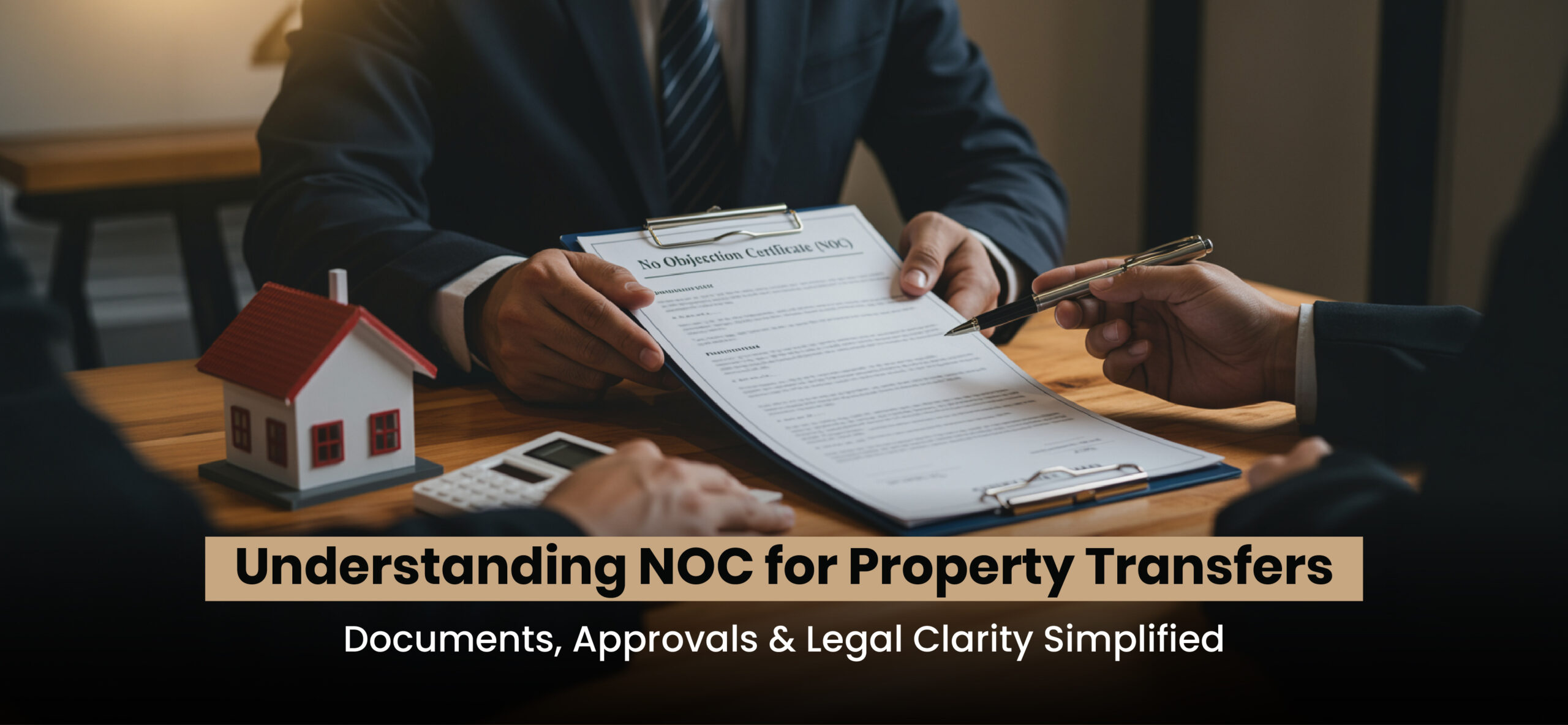
NOC for Property Transfer in India: When It’s Required, Documents, Process & Legal Guidelines
Introduction
In India, purchasing or selling real estate involves several legal procedures in addition to financial considerations. Every document, from contracts to registrations, is crucial.
The NOC for property transfer is one such crucial document. Many sellers and buyers disregard it or think it’s optional. However, in practice, failing to obtain a NOC can cause your transaction to be delayed or possibly lead to future legal issues.
Knowing when and how to obtain a NOC is crucial whether you are buying a resale apartment, selling a property, or transferring ownership.
In this tutorial, we provide a straightforward and useful explanation of the property NOC document, procedure, and legal significance.
What is an NOC in Real Estate?
A legal document known as a NOC (No Objection Certificate) is issued by an authority declaring that they have no objections to the transfer of property from one owner to another.
To put it simply, it is an official confirmation that there are no unresolved difficulties and that the transaction can proceed.
Depending on the kind of property, a NOC may be granted by:
- Apartment associations or housing societies
- A bank or other financial organisation
- Developer or builder
- Local government (in certain situations)
An NOC is used to make sure there are no outstanding payments, legal conflicts, or ownership concerns related to the property.
It is an important part of the property legal checklist India, especially in resale transactions.
When is NOC Required for Property Transfer?
The requirement for an NOC depends on the type of property and transaction. Here are the most common scenarios:
Housing Society NOC
A NOC from the housing society is typically required when purchasing or selling an apartment.
This demonstrates:
- No unpaid maintenance fees
- The transfer of ownership is approved by society.
Bank NOC (Home Loan Cases)
The seller needs to get a NOC from the bank if the property already has a house loan.
This suggests:
- The status of an outstanding loan or its closure
- The transfer is authorized by the bank.
Builder/Developer NOC
For recently completed or ongoing projects, a builder NOC may be required.
This ensures:
- There are no unpaid invoices for the developer.
- Authorisation to move or resell
Local Authority NOC
In certain cases, especially for land or specific zones, local authority approval may be required.
Each of these plays a role in ensuring a smooth property transfer process India.
Step-by-Step Process to Obtain NOC
The society NOC process and other NOC approvals usually follow a similar structure.
Here’s how it typically works:
- Application Submission
Submit a request to the concerned authority (society, bank, or builder). - Document Verification
The authority reviews ownership documents, dues, and transaction details. - Clearance of Dues
Any pending maintenance, loan, or other charges must be cleared. - Approval & Issuance
Once verified, the NOC is issued confirming no objections.
The process is generally straightforward, but delays can happen if documents are incomplete or dues are pending.
Documents Required for Property NOC
Here is a simple checklist of property NOC documents you may need:
- Copy of Sale Agreement
- Property ownership documents
- ID proof of buyer and seller
- No dues certificate from society
- Latest maintenance receipts
- Loan closure certificate (if applicable)
- Application form/request letter
Keeping these documents ready can speed up the process significantly.
Legal Importance of NOC
An NOC is more than just a formality it has real legal value.
It helps:
- Prevent future disputes related to ownership or dues
- Ensure clear and valid property transfer
- Act as proof of approval from concerned authorities
- Support the registration process in many cases
Without an NOC, buyers may face issues later regarding ownership rights or hidden liabilities.
That’s why it is a critical part of the property registration checklist.
Common Mistakes to Avoid
Many buyers and sellers make avoidable mistakes when it comes to NOCs.
Some common ones include:
- Skipping society NOC assuming it’s not required
- Not clearing maintenance or loan dues
- Delaying documentation
- Assuming builder approval is not needed
- Proceeding with registration without complete checks
These mistakes can delay transactions or lead to legal complications later.
Conclusion
The NOC for property transfer is a simple but essential step in the property buying and selling process.
It ensures transparency, protects both buyer and seller, and helps complete the transaction without legal hurdles. Whether it’s a society NOC, bank NOC, or builder approval, each plays an important role in ensuring a smooth transfer.
Before finalising any deal, make sure your documentation is complete and verified.
A little due diligence today can save you from major issues tomorrow.
FAQ
2. How long does it take to get an NOC?
It usually takes a few days to a couple of weeks, depending on the authority and document verification.
3. Can property be transferred without society NOC?
In some cases, yes. But it is not advisable as it may create legal or ownership issues later.
Thank you. Your comment will be visible after an approval.
Comments (0)
No comments found.Featured Articles

Proven Framework for High Velocity Launches
Recent Articles

Why Apartments in Emerging Cities Deliver Higher Real Estate ROI

Mumbai Real Estate Market Forecast 2026: Trends, Prices & Investment Opportunities

10 Common Housing Myths Every Homebuyer Should Stop Believing

Pune’s GCC Boom 2026: Why Global Companies Are Choosing Pune

Pre-Launch Property Buying Guide: Benefits, Risks & Smart Investment Tips
Add your comment