
Categories
Uncategorized

Navi Mumbai International Airport: Project Details, Status and Latest Updates

If you have been hearing about the Navi Mumbai International Airport for years and wondering when it will actually start, you are not alone. For many homebuyers, investors, and even daily commuters, this airport has been one of the most talked-about infrastructure projects in India.

The Navi Mumbai International Airport, also known as NMIA, is being built to reduce the pressure on Mumbai’s existing airport and support the growing population of the Mumbai Metropolitan Region. In 2025, the project has reached an important stage where construction is visibly close to completion. This blog explains the current construction status, development phases, connectivity improvements, and how the airport is expected to impact real estate markets like Panvel, Ulwe, and Dronagiri.

Current Construction Status of NMIA in 2025

As of 2025, the Navi Mumbai International Airport is in an advanced stage of construction. Most of the major structural work has already been completed, and the project has moved into its finishing and testing phase.

The project received its official inauguration earlier in 2025, and all major civil works, including the runway and terminal structures, have been completed. The regulatory authority has already granted the aerodrome licence, and airport authorities are conducting final operational readiness checks.

According to recent announcements, NMIA is scheduled to start commercial flight operations on 25 December 2025, marking a significant moment in India’s aviation history. In the first month, the airport will operate daily for about 12 hours, with planned take-offs and landings managed carefully as systems and services stabilise.

Phases of Development and Expected Launch Timeline

The Navi Mumbai International Airport is being developed in multiple phases to match future growth in air travel and cargo movement.

Phase 1 is designed to handle a large number of domestic and international passengers along with cargo operations. Once operational, it will significantly reduce congestion at Mumbai’s existing airport and improve travel convenience for people living in Navi Mumbai and nearby areas.

The airport is expected to handle around 20 million passengers annually once Phase 1 operations start. Future phases will expand this capacity significantly with potentially up to 90 million passengers per year that to, with additional terminals, runways, and cargo facilities being added over time.

These later stages may unfold through the late 2020s as travel demand grows and more airline operators increase their services from NMIA.

Connectivity Improvements and Infrastructure Growth

One of the biggest advantages of the Navi Mumbai International Airport is the strong infrastructure being developed around it. The airport is supported by multiple road, rail, and metro projects that are transforming travel across the region.

  • The Mumbai Trans Harbour Link has already reduced travel time between South Mumbai and Navi Mumbai significantly. This has made areas near the airport much more accessible for daily commuters and business travelers.
  • The upcoming Navi Mumbai Coastal Road is expected to further improve connectivity within Navi Mumbai. The JNPT corridor upgrades are strengthening movement of goods and supporting industrial and logistics growth.
  • Metro connectivity is another major boost. Metro lines connecting Belapur, Taloja, and Khandeshwar are improving daily travel for residents and future airport employees. Road widening projects, better internal roads, and proposed water transport options are also part of the long-term plan.

Together, these infrastructure upgrades are making Navi Mumbai more connected, livable, and attractive for long-term development.

Impact on Real Estate Prices in Navi Mumbai

One of the most talked-about projects is the Mumbai Trans Harbour Link (MTHL), which dramatically cuts down travel time from South Mumbai to Navi Mumbai. This link is already easing traffic and bringing Ulwe and surrounding areas closer to the city centre.

In addition to MTHL, the Navi Mumbai Coastal Road is being built to improve east-west connectivity along the coast, making travel to the airport smoother for residents of Navi Mumbai. New link roads are also being developed around Morbe Circle and Kalamboli to connect directly to the airport zone, significantly reducing distance and commute times on these routes.

Public transport upgrades are also in progress, including metro expansions that will connect Belapur, Taloja, and Khandeshwar, giving daily commuters affordable and fast options. Improvements to the JNPT corridor and wider road networks further integrate the airport with major freight and logistics routes.

Overall, these connectivity projects are creating an ecosystem where travel to and from the airport becomes more convenient, reliable, and efficient.

Key Beneficiary Locations Around NMIA

  • Panvel is one of the biggest beneficiaries of the Navi Mumbai International Airport. It offers strong road and rail connectivity and is also part of upcoming metro routes. Panvel has seen growing demand for residential projects, commercial developments, and mixed-use spaces. It suits both end users and long-term investors.
  • Ulwe has gained attention due to its close proximity to the airport and direct access through the Mumbai Trans Harbour Link. Improved social infrastructure and planned commercial zones have made Ulwe a preferred location for homebuyers looking for future growth.
  • Dronagiri is still at an early stage of development but holds strong long-term potential. Its proximity to JNPT, availability of land, and upcoming infrastructure projects make it attractive for investors who are willing to wait for appreciation over time.

Choosing the right location depends on budget, investment timeline, and whether the property is meant for self-use or investment.

Conclusion

The Navi Mumbai International Airport is set to redefine the region’s connectivity, economic activity, and real estate landscape. With commercial operations set to start on 25 December 2025, the airport will begin its journey as an important aviation hub for the Mumbai region. For homebuyers and investors, tracking NMIA’s development is essential for making informed decisions. Infrastructure-led growth rarely happens overnight, but when it does unfold, it reshapes cities for decades to come.

Categories
Uncategorized

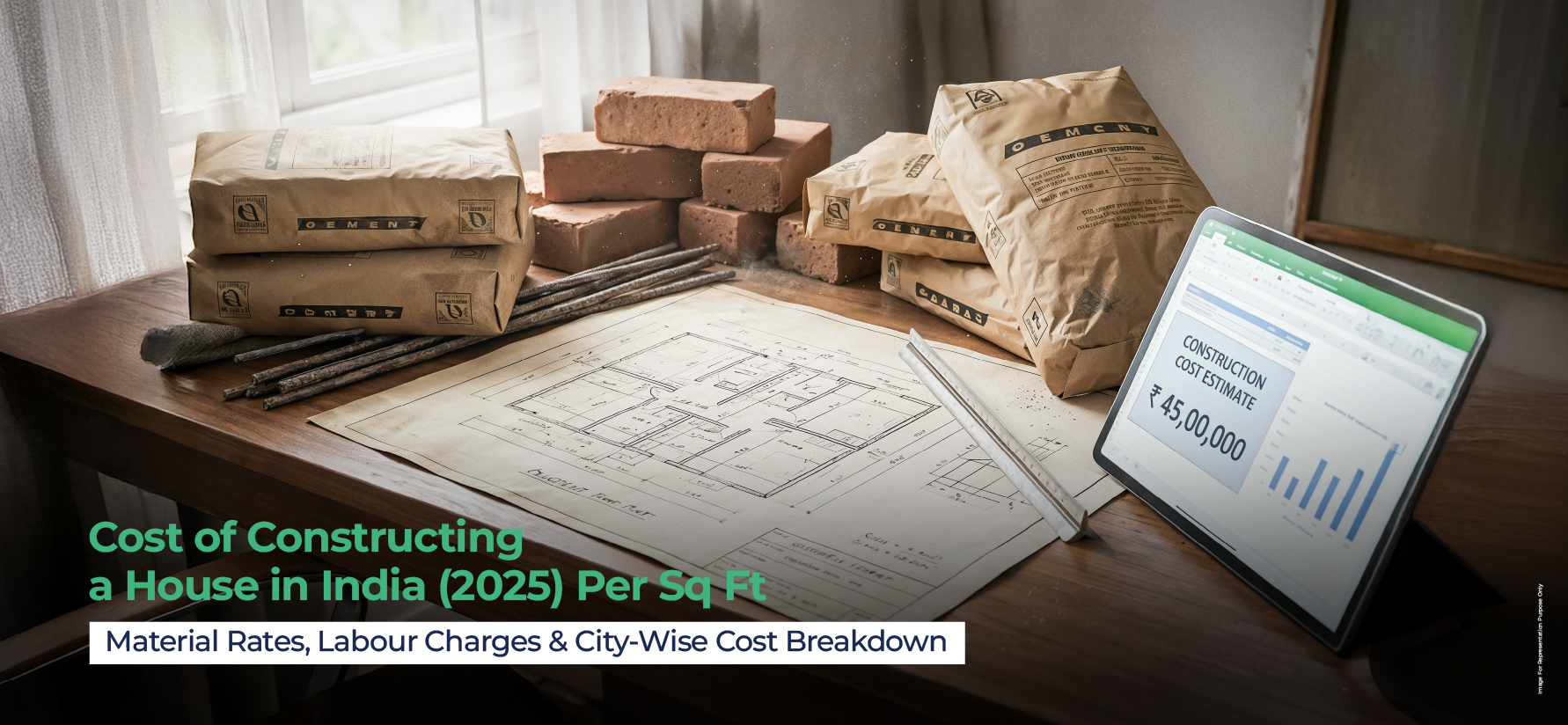
Cost of Constructing a House in India (2025): Per Sq Ft Explained

If you own a plot or are planning to build a house, this question usually comes up very early in the conversation: “Kitna kharcha aayega?”

The truth is, construction costs in India are not fixed. They keep changing every year. In 2025, prices have gone up again because of rising material costs, higher labor wages, and increased demand for better-quality homes. What used to fit comfortably in a budget a few years ago now needs careful planning.

This blog helps you understand the actual cost of constructing a house in India in 2025, explained in simple terms. You will learn the latest per sq ft costs, what goes into that cost, how prices differ across cities, and how to plan your budget without unnecessary overspending.

Updated Construction Cost per Sq Ft in India (2025)

In 2025, the cost to construct a house in India varies a lot depending on the type of finish you want and where you’re building it. In general:

  • For basic construction using standard materials and finishes, costs can start from around ₹1,500 to ₹2,000 per sq ft. This would typically cover walls, roof, basic flooring, simple plumbing, and electrical work woven into the structure.
  • For standard or mid-range construction, where you plan better quality materials, improved finishes, and more comfortable interiors, the cost usually falls roughly between ₹1,800 to ₹2,800 per sq ft.
  • For premium or luxury construction, where you use branded fittings, imported tiles, designer bathrooms, smart home systems, and higher aesthetics, the cost can go ₹2,800 to ₹3,500+ per sq ft or even higher in big cities.

These are broad ranges, and actual numbers depend on your design, contractor, location, and the quality of materials you choose.

Where Your Construction Money Actually Goes

Many homeowners think construction cost is mostly about cement and bricks. In reality, the budget is spread across several components.

Materials take up around 40 to 50 percent of the total cost. This includes cement, steel, sand, bricks, tiles, plumbing pipes, electrical wiring, and fittings. In 2025, steel and cement prices remain sensitive to market demand, which directly affects construction budgets.

Labour accounts for about 20 to 25 percent of the cost. This includes masons, carpenters, electricians, plumbers, painters, and helpers. Labour wages have increased steadily, especially in urban areas, due to higher demand and skilled worker shortages.

Architect and structural engineer fees usually form 5 to 10 percent of the budget. These professionals ensure your house is safe, legally approved, and well-planned. A good design can actually save money by reducing waste and future modifications.

Government approvals and permissions take up around 2 to 5 percent. This includes building plan approval, water connection, electricity connection, and local authority charges.

Interior work can take anywhere between 20 and 30 percent of the total budget. Modular kitchens, wardrobes, false ceilings, flooring upgrades, and painting all fall into this category and can easily increase costs if not planned carefully.

How Construction Cost Changes from City to City

Construction costs are not the same across India, even for the same quality of work.

In metro cities like Mumbai, Delhi, and Bangalore, construction costs are usually higher. Labour wages are higher, contractor margins are steeper, and transportation costs for materials add to the budget.

In Tier-1 cities such as Pune, Hyderabad, and Ahmedabad, costs are slightly lower but still competitive. Availability of skilled labor and local material suppliers helps control expenses to some extent.

In Tier-2 cities like Indore, Coimbatore, and Kochi, construction costs are more affordable. Labour is cheaper, and local sourcing of materials reduces transportation costs.

In Tier-3 towns and rural areas, construction can be significantly cheaper. However, availability of skilled labor and branded materials may be limited, which can affect quality if not managed properly.

How to Save Money Without Compromising on Quality

Saving money during construction does not mean cutting corners. It means making smart decisions.

Using good-quality local brands instead of expensive imported materials can reduce costs without affecting durability. Choosing simple and efficient designs helps reduce material wastage and labor time. Complex designs often look good on paper, but cost more to execute.

Buying materials in bulk during off-season discounts can result in significant savings. Avoiding last-minute changes is also very important, as rework increases both labor and material costs.

Interior planning should be based on actual usage. Not every room needs premium fittings. Working closely with an architect helps optimize layouts, reduce waste, and plan materials better from the start.

How to Estimate Your Construction Budget in 2025

Budgeting becomes much easier when broken into steps.

Start with a simple formula:
Total Built-up Area × Cost per Sq Ft

For example, if you are building a 1,500 sq ft house at a mid-range cost of ₹2,600 per sq ft, your basic construction cost comes to ₹39 lakh.

To this, add:

  • Interior budget
  • Approval and professional fees
  • A contingency buffer of 5 to 10 percent for price fluctuations and unexpected expenses

Tracking material prices during construction is important because rates can change within months, especially for steel and cement.

Conclusion

Building a house in 2025 is not just about bricks and cement; it is about planning every rupee wisely. Construction costs will continue to rise with material prices, labor charges, and design expectations, which is why understanding the real per sq ft cost, cost breakup, and city-wise variations becomes extremely important. With the right budgeting, professional guidance, and timely decisions, you can avoid overspending and unnecessary stress. Platforms like BeyondWalls help homebuyers and plot owners stay informed with updated real estate insights, cost trends, and expert guidance, making it easier to plan construction decisions with clarity and confidence.

Calculate Your Construction Budget

Categories
Uncategorized

Can Mistakes in Property Documents Be Rectified?

Accuracy in property documents is extremely important because these papers legally establish ownership, rights, and responsibilities related to a property. Most homebuyers and property owners assume that once a sale deed is registered, everything is permanently correct. However, in reality, documentation errors are quite common and often go unnoticed for years.

These issues usually surface during critical moments such as applying for a home loan, selling the property, transferring ownership, or during inheritance planning. Even a small error can create confusion, delays, or legal complications. The reassuring part is that most property document mistakes can be corrected legally if identified and handled correctly. This blog explains the common types of errors, the legal remedies available, the cost and timelines involved, and how such mistakes can be avoided in the future.

Common Errors in Property Documents

Property document errors are more common than people realise. They usually happen due to human oversight, outdated records, or clerical mistakes during registration.

Here are some of the most frequent ones:

1. Name Spelling Mismatch

Even a missing letter or surname variation between Aadhaar, PAN, and the sale deed can create issues, especially during resale or loan processing.

2. Incorrect Address or Survey Number

Errors in flat number, building name, CTS number, or survey number can raise red flags with banks and legal teams.

3. Area, Dimension, or Boundary Discrepancies

Mismatch between carpet area, built-up area, or boundary descriptions can affect valuation, taxation, and future transactions.

4. Wrong Property Type or Classification

Residential shown as commercial (or vice versa), NA status missing, or incorrect land category can create legal complications.

5. Typographical Errors in Sale Deed or Agreement

Wrong dates, missing clauses, or incorrect references, these may look minor but can delay or derail transactions.

These mistakes impact ownership clarity, loan approvals, resale timelines, and even inheritance transfers. Which is why rectifying them early is always advisable.

Legal Ways to Rectify Property Document Errors

The legal system provides structured solutions to correct property documentation errors. The appropriate method depends on the nature and severity of the mistake.

Rectification Deed

A rectification deed is the most reliable and legally accepted method for correcting material errors in a registered sale deed or agreement. It is used when the mistake affects ownership details, property description, area, boundaries, or other significant terms.

This deed must be executed jointly by both the buyer and the seller, as it amends the original agreement signed by both parties. The rectification deed clearly states the error and mentions the corrected information. Once drafted, it must be registered at the Sub-Registrar Office.

Stamp duty for a rectification deed is generally nominal and varies from state to state. Registration charges are also applicable as per local rules. After registration, the rectification deed becomes a legal extension of the original sale deed.

Affidavit for Minor Errors

For minor clerical mistakes, a rectification deed may not be necessary. In such cases, an affidavit can be used to declare and clarify the correct information.

Affidavits are typically accepted for spelling errors, name expansions, or minor typographical mistakes that do not affect ownership, boundaries, or property identity. The property owner executes an affidavit stating the mistake and the correct details.

Affidavits are commonly used for bank records, housing society transfers, or utility updates. However, they are not suitable for correcting substantial legal or ownership-related errors.

Correction Through the Sub-Registrar Office

Some errors originate from government records rather than private agreements. These include incorrect survey numbers, mapping discrepancies, Index II errors, or mismatches in land records such as 7/12 extracts or property cards.

In such cases, an application must be submitted to the Sub-Registrar Office along with supporting documents. The authorities verify the claim, and once approved, the correction is updated in official records. This process generally takes longer but is essential for ensuring long-term clarity and compliance.

Legal Ways to Rectify Property Document Errors

The law recognizes that mistakes happen. What’s important is correcting them through the right legal route, based on the nature of the error.

1. Rectification Deed

This is the most common and legally sound method for correcting major errors.

What is it?

A rectification deed is a legal document executed to correct mistakes in an already registered sale deed or agreement.

When should it be used?

  • Name corrections
  • Area or boundary changes
  • Wrong property details
  • Any material change affecting ownership or description

Who executes it?

Both buyer and seller must jointly sign the rectification deed, since it amends the original agreement.

Registration & Fees

  • The deed must be registered at the Sub-Registrar Office
  • Stamp duty is usually nominal (varies by state)
  • Registration fees apply as per local rules

Once registered, the rectification deed becomes legally attached to the original sale deed.

2. Affidavit for Minor Errors

Not all mistakes require a full rectification deed.

When is an affidavit acceptable?

  • Minor spelling errors
  • Name expansion or abbreviation
  • Clerical or typographical mistakes

How it works

  • Property owner executes an affidavit
  • States the error and the correct information
  • Used mainly for bank records, society transfers, or utility updates

However, affidavits are not suitable for ownership-related or boundary-related errors.

3. Sub-Registrar Office Correction Process

Some errors originate from government records rather than private documents.

When is this needed?

  • Incorrect survey numbers
  • Plot mapping issues
  • Index II errors
  • Land record mismatches (7/12, property card)

Process Involved

  • Submit an application to the Sub-Registrar
  • Provide supporting documents
  • Verification by authorities
  • Correction entry made in official records

These corrections take longer but are essential for long-term clarity.

Documents Required for Rectification

While requirements may vary slightly, most rectification processes require:

  • Original sale deed or agreement
  • ID and address proof of buyer and seller
  • Supporting documents (Aadhaar, PAN, previous agreements)
  • Municipal tax receipts or land records
  • Draft rectification deed
  • Application letter to Sub-Registrar

Having complete documentation upfront speeds up the process significantly.

Timelines & Cost Involved

The time and cost depend on the type of correction.

Affidavit

  • Timeline: 2–5 working days
  • Cost: Minimal (stamp paper + notarisation)

Rectification Deed

  • Timeline: 1–3 weeks (depending on party availability)
  • Costs involved:
    • Nominal stamp duty
    • Registration charges
    • Lawyer drafting fees

Registrar-Level Corrections

  • Timeline: 3–8 weeks or more
  • Cost varies based on verification and document complexity

If the seller is unavailable or untraceable, the process may involve additional legal steps and time.

Tips to Avoid Future Property Document Errors

Prevention is always better and cheaper than correction.

  • Double-check names, addresses, and area details before registration
  • Cross-verify Index II, 7/12, property card, and encumbrance certificate
  • Engage a legal expert during drafting and registration
  • Conduct a property document audit before resale or loan application
  • Never rely solely on verbal assurances, you should always insist on written clarity

These small steps can save months of stress later.

Conclusion

Mistakes in property documents can create unnecessary stress, but they are rarely irreversible. Most errors can be legally corrected if identified early and addressed through the appropriate legal process. Timely action ensures smoother transactions, clearer ownership, and long-term peace of mind.

Platforms like BeyondWalls help property owners and homebuyers navigate these complexities with verified information and expert-backed guidance. Because in real estate, true security comes not just from owning property, but from having paperwork that is accurate, complete, and future-ready.

Categories
Uncategorized

Income from House Property: How Is Rental Income Taxed in 2025–26?

Let’s start with something simple.

If you own a house and earn rent from it, chances are you’ve asked yourself this at least once: “Am I paying more tax than I should?”

For many people, rental income isn’t something they planned to become experts in. It usually starts innocently where it’s just a second home bought for the future, a flat inherited from parents, or an investment made when property prices felt reasonable. The rent comes in every month, life goes on… until tax season arrives.

Suddenly, you’re dealing with terms like Income from House Property, GAV, NAV, and the never-ending confusion of old vs new tax regime. And with FY 2025–26 bringing more clarity but also more choices, understanding how rental income is taxed has become more important than ever.

This blog simplifies everything from how rental income is calculated to what deductions you can claim, and how to legally reduce your tax burden without missing out on benefits you deserve.

How Is Rental Income Taxed in FY 2025–26?

First things first: rental income in India is taxed under the head “Income from House Property.” This applies whether you’re a salaried professional, a full-time investor, or an NRI owning property in India.

Types of Properties & Their Tax Treatment

1. Self-Occupied Property

If you live in the house yourself, there’s no rental income to tax. Simple. However, you may still be eligible for home loan interest deduction, depending on the tax regime you choose.

2. Let-Out Property

If your property is rented out, the rent becomes taxable but not before deductions. This is where many landlords overpay tax due to lack of awareness.

3. Vacant Property

If your house remained vacant for part of the year despite genuine efforts to rent it out, you get a vacancy allowance. You are not taxed on income you never earned.

Old vs New Tax Regime (FY 2025–26)

  • Old Tax Regime: Allows deductions like home loan interest under Section 24(b).
  • New Tax Regime: Offers lower tax slabs but restricts many deductions related to house property.

If you have a home loan, the old regime usually makes more financial sense.

For NRIs

If you’re an NRI, your tenant must deduct TDS at 30% before paying rent. The good news? You can still claim a refund if your actual tax liability is lower.

Understanding GAV & NAV

This is where most confusion begins, but it’s actually quite straightforward.

What Is Gross Annual Value (GAV)?

GAV is the higher of:

  • The actual rent you received, or
  • The expected rent based on market or municipal value

If your property was vacant for a few months, the law is practical that rent is not considered.

Municipal Taxes

Only municipal taxes actually paid during the year can be deducted.

Net Annual Value (NAV)

Once municipal taxes are deducted from GAV, you get Net Annual Value.

Formula: NAV = GAV – Municipal Taxes Paid

Simple Example:

  • Monthly rent: ₹25,000
  • Rent received in the year: ₹3,00,000
  • Municipal taxes paid: ₹20,000

NAV = ₹3,00,000 – ₹20,000 = ₹2,80,000

This ₹2,80,000 is what your tax calculation starts from.

Deductions Available for FY 2025–26

This is the section every landlord should read carefully.

A. Standard Deduction – 30%

Once NAV is calculated, you automatically get a 30% deduction.

  • No bills required
  • Covers repairs, maintenance, painting, wear and tear
  • Applicable only to let-out properties

Using the earlier example: 30% of ₹2,80,000 = ₹84,000 deduction

This deduction exists because the law understands that properties need upkeep, even if you don’t claim expenses individually.

B. Home Loan Interest Deduction (Section 24(b))

This is one of the biggest tax-saving tools for landlords.

For Self-Occupied Property

  • Maximum deduction: ₹2,00,000 per year
  • Available only under the old tax regime

For Let-Out Property

  • No upper limit on interest deduction
  • Entire interest paid during the year can be claimed

This is why people with rented properties and home loans often pay very little tax on rental income — when calculated correctly.

Pre-Construction Interest

  • Interest paid before possession is allowed
  • Claimed in 5 equal instalments after the property is completed

C. Joint Home Loan Benefits

If the property is jointly owned and both owners are co-borrowers:

  • Each person can claim deductions separately
  • Ownership share should be clearly mentioned
  • Works well for couples and family-owned properties

This is one of the most effective and underused tax planning strategies in real estate.

Tax Slabs & Exemptions Explained Simply

Rental income doesn’t get taxed separately. It is added to your total income and taxed according to your slab.

Old Tax Regime

  • Allows standard deduction
  • Allows home loan interest deduction
  • Better suited for landlords with loans

New Tax Regime (FY 2025–26)

  • Lower slabs
  • Limited house property deductions
  • Often results in higher tax for landlords

NRIs

  • 30% TDS deducted by tenant
  • Actual tax may be lower
  • Refund can be claimed while filing returns

How to Reduce Rental Income Tax Legally

Here are practical steps that actually work:

  • Choose the right tax regime based on loan interest
  • Opt for joint ownership where possible
  • Claim vacancy allowance honestly
  • Keep municipal tax receipts
  • Plan home loan interest smartly
  • NRIs should declare net rent after TDS, not gross

These aren’t loopholes, in fact they’re benefits already allowed by law.

Conclusion

Rental income taxation isn’t about complex formulas, but it’s about understanding how GAV, NAV, and deductions work together and using them correctly. In FY 2025–26, a small mistake in calculation or choosing the wrong tax regime can easily lead to paying more tax than required.

This is where platforms like BeyondWalls add real value. By combining verified property insights, expert guidance, and a deeper understanding of how real estate and taxation intersect, BeyondWalls helps property owners and investors make more informed decisions. Check Your Tax Benefits.

Categories
Uncategorized

Your Building May Soon Be Checked: What MHADA’s 2025 Structural Audit Means for You

Mumbai is a city filled with decades-old structures, and many of these buildings have stood long past their intended lifespan. Many these ageing structures fall under the category of “cessed buildings,” which are known for their chronic repair issues and high safety risks. Recently, MHADA announced that it will conduct a structural audit of 1,000 cessed buildings by March 2025. This announcement has brought new attention to the condition of these buildings and the potential threats they pose to residents. As several building collapses have occurred in Mumbai in recent years, the need for a thorough and timely audit has become more urgent than ever. This blog explains why these buildings are under scrutiny, what the audit means, and how residents and buyers should prepare.

What Are Cessed Buildings?

Cessed buildings are old residential or commercial structures built before 1969. These buildings pay a special tax known as “cess” to the Mumbai Building Repair and Reconstruction Board (MBRRB), which is a part of MHADA. The purpose of this cess is to fund essential repairs and maintenance work for these ageing structures. Cessed buildings are usually classified into three categories based on their age:
Category A includes buildings constructed before 1940,
Category B includes those built between 1941 and 1950, and
Category C includes structures constructed between 1951 and 1969.

Most of these buildings suffer from multiple problems such as water leakage, weak foundations, worn-out beams, and outdated electrical systems. Maintenance delays, inadequate repair funds, and disputes between tenants and landlords often make the situation worse. Over time, these issues can cause serious structural instability, making some of these buildings vulnerable to partial or complete collapse. This risk is especially high during the monsoon season, when weakened structures struggle to withstand heavy rainfall.

Why These Buildings Are Considered High-Risk

There are several reasons why cessed buildings are seen as high-risk structures. Many of them are more than 60 to 80 years old, which means their original building materials have long weakened. According to various reports, a significant percentage of building collapses in Mumbai involve pre-1970 structures, with cessed buildings forming a major part of that group. These buildings often house a high population density with multiple tenants living in small units. This makes evacuation extremely challenging in case of an emergency.

In many cases, redevelopment plans have been stuck for years due to disagreements between tenants, landlords, and developers. As a result, residents continue to live in unsafe buildings that urgently require either major repairs or complete reconstruction. Some buildings lack proper fire safety systems, functioning lifts, or stable staircases. These issues collectively make cessed buildings one of Mumbai’s most vulnerable categories of real estate.

MHADA’s 2025 Structural Audit Plan

To reduce safety risks and prevent further collapses, MHADA has announced that it will conduct structural audits of 1,000 cessed buildings by March 2025. The primary goal of this project is to assess the health of ageing structures and identify which buildings require immediate evacuation, repairs, or redevelopment. The audit will focus first on the most dilapidated buildings, as they pose the highest danger to residents.

During the audit, structural engineers and on-ground teams will carry out detailed inspections to check for cracks, corrosion, weakened foundations, and water damage. They will also evaluate the load-bearing capacity of each building and determine whether repairs are possible or if redevelopment is the only safe option. After the inspection, each building will receive a safety certification that states whether the structure is safe to live in.

This audit is expected to push forward long-delayed redevelopment projects and ensure that residents no longer have to live in dangerous conditions. It will also help the government update its records and create a clear, transparent list of risky buildings that require urgent attention.

Safety Implications for Residents and Buyers

Residents living in cessed buildings should take audit notifications very seriously. Once a building is declared unsafe, authorities may issue evacuation notices to protect the lives of the occupants. In some cases, residents may be asked to shift to temporary accommodation or transit camps until repairs or redevelopment are completed. The audit results may also lead to mandatory repair work that needs to be completed within a specific timeframe.

Buyers interested in purchasing property in Mumbai should also pay close attention to the condition of cessed buildings. Investing in an extremely old building without understanding its structural condition can lead to financial and legal complications later. Prospective buyers should always check the latest audit status, structural reports, redevelopment progress, and tenant-developer agreements before making a decision. It is also important to understand your rights as a tenant or a buyer, especially with regard to redevelopment benefits and compensation in case of evacuation.

Redevelopment Opportunities for Mumbai’s Real Estate

Although cessed buildings pose several risks, they also offer tremendous redevelopment potential. Many redevelopment projects in Mumbai have transformed small, old structures into modern towers with larger homes, better amenities, and higher property values. Residents who live in these buildings can benefit from bigger apartments, improved infrastructure, and modern facilities after redevelopment.

The government has also introduced various incentives to encourage redevelopment, including FSI (Floor Space Index) benefits, fast-track approvals, and support from MHADA and BMC. However, redevelopment can still face challenges such as delays, disputes among stakeholders, and financial risks if the chosen developer is not reliable. Residents and societies must choose developers carefully and ensure that agreements are clear, transparent, and legally sound.

Conclusion

MHADA’s 2025 audit of Mumbai’s old cessed buildings is an important step toward improving safety and accelerating redevelopment across the city. These audits will help identify buildings that are unsafe, ensure timely repairs, and encourage communities to plan redevelopment in a more structured way. For residents, tenants, and buyers, this is the right time to stay informed and take the condition of their buildings seriously. By understanding the risks and upcoming changes, people can make better decisions about safety, investment, and long-term living conditions in Mumbai’s evolving real estate landscape.